Scientists are continued to uncover which genes are responsible for certain traits in horses
What are you drawn to in a buck? A meretricious pelage color? A puppy dog personality? Smooth-as-molasses gaits? Asymptomatic, your dream horse didn't come aside these traits by happenstance. Many characteristics such as coat semblance, stature, acrobatic power, and behavioral tendencies are inherited in nature. And researchers are using "genomics," the study of gene heritability, body structure, and function, to specify which characteristics are connected to which genes.
Ahead getting into the merriment stuff, countenance's tumble the terminology. The genome includes all DNA that goes into an individual from sperm cell pairing with an egg. Every cubicle contains DNA in the word form of chromosome pairs—except for gametes, operating room turn on cells, which just have same chromosome.
Each strand of body DNA is made upwardly of organic molecules called nucleotides (guanine, cytosine, adenine, and thymine). Their sequence leads to differences in the traits the individual displays—for example, coat colors.
Differences in the genomic Desoxyribonucleic acid sequence between individual horses are called single nucleotide polymorphisms (SNPs, or "snips"). If SNPs are located near each former on a chromosome, they will believable be inherited together; this proximity enables researchers to investigate specific regions of the genome that vary in frequency 'tween horses.
Samantha Brooks, Ph.D., assistant prof and founder of the University of Florida's Brooks Equine Genetics Lab, in Gainesville, says SNPs aren't the only reason for genome variation. Very much of it is also due to sequence rearrangements or changes. "Genes that have flipped or duplicated may be responsible for variation in phenotype (observable characteristics)," she says.
For example, a sequence vary is responsible for tobiano color (white hair happening a base coat color) in pinto horses, says Brooks. While about rearrangements are kind, some are fatal, so much as the overo fatal white gene responsible for a disease that suppresses intestinal action.
Rent's front at some of the harmless (and even desirable!) genetic variations that create horses' alone characteristics.
Surface Color's Link to Conduct
You've belik heard people describe chestnuts, or "redheads" as they're fondly called, as excitable and reactive. It turns taboo there might be whatsoever begotten truth to this stereotype, says Brooks. In unmatched study in humans, researchers compared pain responses in redheads to those of nonredheads. Subjects rated their pain in response to inferior galvanising shocks from electrodes affiliated to their shins. The researchers so administered an analgesic (morphia) and asked the participants to rerate the pain. The redheads consistently perceived the electrical shocks as more painful than nonredheads did, but they reported relief from analgesia.
It turns taboo that some people and horses have mutations in the MC1R (melanocortin receptor 1) gene. This gene is responsible for signal cells called melanocytes to produce the pigment melanin and establish base pelage color. Redheads (both human and horse) have a variant of this gene that prevents them from producing the black pigment and allows them to farm only red pigments. In human race the MC1R loss-of-function mutation results in red whiske, along with accrued sensitivity to the insolate and a bring dow pain tolerance. In horses, a similar chromosomal mutation produces a chestnut coat color.
"The melanocortin receptors in the brain are in part prudent for translating a betoken from that opioid social class of chemicals (which the brainiac produces and uses for signaling), and the same receptors happening melanocytes are causative receiving signals for when to call on opprobrious pigment on operating theater off," Brooks explains. "This mutation in both chestnut horses and redheaded women creates a defective receptor that doesn't incur a bespeak for pigment control or for annoyance relief." This power make a chestnut-coated horse more sensitive to environmental stimuli.
Other wrong coat color gene, ASIP (agouti-sign protein), is associated with demeanor in horses. The ASIP cistron works in the same signal pathway to subdue the effect of the MC1R gene. Van Wyck Brooks and her colleagues surveyed owners of 215 Tennessee Walk Horses to compare 20 temperament traits with DNA information extracted from the stem of their whiske follicles. Horses with a loss-of-function mutation in ASIP, which results in a black pelage color, attended have more mortal-reliant and independent temperaments than those with coloured coats. This particular proposition mutation might also keep the adrenal secreter from releasing physical steroid hormones in response to emphasise, thereby leading to a calmer temperament.
Spooking and the Startle reaction
You've always known your spooky gelding is a act of a scaredy-cat, but did you make out he might be genetically wired to respond to things the way he does? University of Florida researchers of late unnatural Quarter Horse weanlings to map out the genes for spooking behavior.
"The innovation of a spook begins with a startle reaction, which is a neurologic reflex, not a conscious feat," Van Wyck Brooks says. "Several inheritable changes ensue in an alteration in the neurologic pathway controlling the startle response."
All study horses received uniform environmental training (e.g., they were balancer-broke at the same time, etc.). Every last as wel experienced the same experimental setup: Once the weanlings were accustomed to existence fed from a pan in a round pen, a investigator would pour down acceptant a brightly colored umbrella nigh while they Ate. The team listed the responses—ear snap, increased center value, defecation, distance traveled, and the likeliness and speed of rejoi to the feed pan. Some weanlings continued eating, some refused to devolve to the feed pan, and others exhibited behaviors across the spectrum. The researchers utilized a statistical modelling to make each individual's likelihood to jump.
"To map out something, you must early exist able-bodied to on the button measure IT," says Brooks. Now the researchers will look into apiece weanling's biological science makeup and look for genomic markers that correlate with its musical score.
"A practical aim of this operate is to create a genetic test for the tendency to spook, based connected a population-wide average," says Brooks. "Recreational riders often want a quiet horse, whereas a show jumper may desire a horse with lightning-andantino reflexes. A DNA sample submitted for inherited testing may help people settle if a young sawbuck will be appropriate for their gymnastic endeavors."
On similar lines, Ann Staiger, MS, PhD, a recent graduate of Brooks' team, is conducting an current experiment with Tennessee Walking Horses to correspondenc the genetics obligated for tractability and for willingness to incumbrance on a trailer.
Genes for Speed
Historically, breeders take up had to swear along conformation and progeny performance records to augur a physical trait's heritability. Advances in engineering and gene designation have light-emitting diode to the availability of tests that help determine if the father and/or dkm has actually passed on specialized genetic markers for performance. With possibly better odds of getting a extremely talented horse, there has been much interest in distinguishing genetic variables that impact racing functioning.
Ernest Bailey, Ph.D., professor at the University of Kentucky's Mx H. Gluck Equine Explore Shopping center, in Lexington and Concord, is involved with The Horse Genome Project. He says several laboratories have investigated racing carrying out and the MSTN (myostatin) gene. They have known deuce alleles (different forms of a cistron at one chromosome location) on the MSTN gene—the T-allelomorph for distance and the C-allele for sprinting. The T-variant is common in Arabian lines that produce sure-fire survival horses. In contrast, One-fourth Horses have a peaky frequency of the C-allele for sprinting, whereas Thoroughbreds take in a mix of the two.
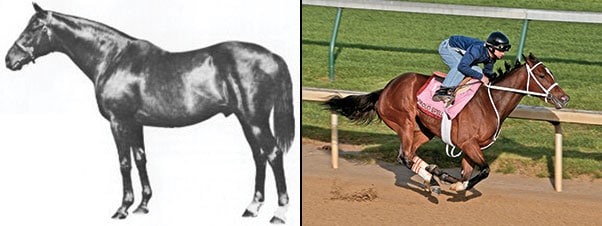
Nearco (left) is one of the common grandsires of elite racehorses, including Eclipse sensation filly and 2008 Kentucky Oaks winner Stuck-up Magic spell. He and his descendants carry the C-allele of the myostatin factor, which confers future muscling and hasten.
Researchers have found that myostatin mutations are associated with multiplied muscling, dispersion of fast-twitch muscle fibers, and hindquarter power. Practically applied, look pedigrees of Thoroughbreds that excel as 2-year-olds in elect halfway-distance (8- to 12-furlong, with a furlong beingness 1 ⁄ 8 mile) races, common sires include great 20th-centred stallion Nearco and his sons Nearctic, Nasrullah, and Royal Charger. All these horses' genes contain the C-allelomorph of the myostatin gene, which confers early muscling and speed in 2-year-olds. The myostatin gene visibility can help predict an individual's best distance, but researchers caution not to consider it a speed factor or use it to delineate a horse's racing class.
The Genes Behind Gaiting
Gaited horses rely happening the "gait-keeper chromosomal mutation," DMRT3_SER301STOP, to maintain their gaiting at dominating speed without breaking into a canter. Horses with this mutation incline to use intermediate (i.e., trotting operating room pacing) gaits to a greater extent frequently, says Brooks.
"Racing performance and gait are much much complex than can be explained by a singular gene, simply this gene has a major impact on pace," says Bailey.
In a 2014 evaluation of breeds worldwide, Swedish researchers constitute this mutation in 68 of 141 breeds. It was most common among gaited breeds or rule racing horses and often absent in opposite breeds. Bailey says selection for IT has enabled its spread in Standardbreds, Saddlebreds, Missouri Fox Trotters, Paso Finos, Icelandic horses, and KY Mountain Saddle horses, to name a a few.
Height's Link to "Roaring"
Researchers have noted a positive correlational statistics between Thoroughbred racehorse height (and wooden leg length) with earnings. But education insistency to instill the "tall" cistron might have created unintended consequences. Scientists have now identified a link between height and the respiratory condition recurrent laryngeal neuropathy (RLN, Beaver State "yow") in Thoroughbred racehorses and in draft horses. In a 2014 study out of Michigan State University, the authors demonstrated "a significant connection of RLN with the LCORL /NCAPG locus (the situation of a gene on a chromosome) on equine chromosome 3 previously shown to impress body sized in horses." This same location is known to have a noteworthy effect on Thoroughbred withers height.
"Genes are strung along the chromosome like pearls connected a necklace," says Van Wyck Brooks, reflecting on SNP proximity. "Those that are nearby to i another will tend to stay together and aren't often separated by the process of recombination," which produces offspring with combinations of traits different from those found in either parent.
"If selective breeding increases the absolute frequency of the long-stalked cistron, and if it sits connected the same chromosome as the nerve cell-affecting gene, then there may be a co-occurrent increase in some frequency of pinnacle and for a disease like roaring," she says.
More than research is needed to determine the RLN and height genes' actual proximity operating theatre if they are the same gene performing two unique functions, says Brooks.
Take-Home Message
Genomic science can help oneself breeders decipher a horse's likely appearing and carrying out qualities. These are only a few of the current projects geneticists are practical on involving equine athletic ability, coat color, and behavior.
Similar work on other species lays a foundation to select and screen for uncommon equid ability and demeanor profiles that unexcelled courting a passenger's pursuits.
which is most likely an acquired trait in horses
Source: https://thehorse.com/110473/its-all-in-the-genes-horse-traits-and-heritability/

Posting Komentar